


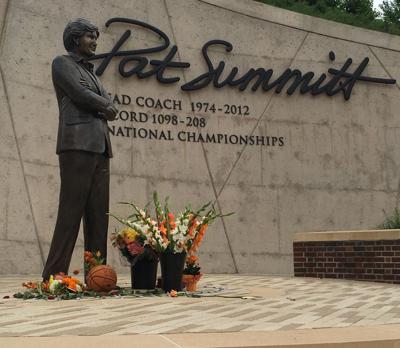
The death of Pat Summitt, who headed the University of Tennessee Lady Vols basketball program for 38 years before retiring in 2012, has made an impact, not only students, teachers and alumni at the University of Tennessee in Knoxville, but on East Tennessee and much of the sporting world. Respect for Summitt was easy to see on the UT campus, Chris Wampler, Lenoir City High School graduate and former UT football player, said.
“I was around early on in her career when I was there,” Wampler said. “All I saw her do was just make a difference. Later on over the past eight or 10 years I’ve been around her in a different capacity with the UT Lettermen. … Everybody around there had football credentials on football game day. Dave Hart had them, everybody had them. Except Pat. Pat didn’t need them. She could just go wherever she wanted to go and that just speaks to the respect people had for her and how much the university cared about her.”
LCHS girls basketball coach Tim Smith said the coach set the bar for those that followed in her footsteps.
“She made something everybody wanted to strive to be,” Smith said. “Her success, everybody wanted to emulate her in some way. Even if it was elementary school or high school. Everybody wanted to emulate her love and her toughness and her success.”
Summitt, who was diagnosed with early-onset Alzheimer’s disease in 2011, is credited with putting Lady Vols basketball on the map, amassing more wins in her career than any Division I basketball coach.
Glenn McNish, general manager of WLIL radio and long-time voice of Lenoir City athletics, said he remembers the changes in the sport at the time Summitt came to Tennessee.
“Obviously when Pat Summitt came along there was not a recognized sport in the NCAA for women’s basketball,” McNish said. “We had a couple of players from Lenoir City that played on the very early Lady Vols basketball team. Since it wasn’t a recognized sport, what they did is they had sort of a state championship.
“... They had to buy their own uniforms. There was no money, so they bought their own uniforms and payed their own way,” he added. “About the time that Pat Summitt came along all of that changed. I guess you could say she was one of the pioneers there really of women when it became a recognized sport there in the NCAA.”
Smith had the opportunity to meet Summitt on more than one occasion.
“I talked to her two or three times and always got — it was just like you were talking to one of your friends,” Smith said. “She wasn’t ever above you or wasn’t ever better than you. It was almost like you were a colleague. It felt like she was learning from you when you were there learning from her.”
As a coach of girls basketball, Smith still sees the impact Summitt made on the sport to this day.
“It exponentially improved the sport,” he said. “It made it jump forward because there was so much respect for her that it brought respect for women’s post. We’re still fighting that fight today … but her success all around changed how we saw girls. It’s OK for girls to play sports. You can be a girl and woman and still be athletic.”
Summitt died early Tuesday morning.
Angela Wampler, organizer of the Forget Me Not 5k, an event that raises money for the Pat Summitt Clinic for Alzheimer’s at the UT Medical Center, praised Summitt’s integrity.
“I think she was one of a kind,” Wampler said. “She was a legend because of all of her accolades. She was a hero to a lot of people. She was classy on the court and off the court. She really cared about people. Whether they are playing for her or just a fan, family friends or whatever. She had a lot of integrity.”
Wampler said the work Summitt has done for Alzheimer’s will continue beyond her death.
“Her legacy will live long,” Wampler said. “She has touched folks with her life, and now she’ll touch folks with her death.”
For Chris Wampler, there is no doubt Summitt will be remembered for a long time.
“She has proven her coaching ability,” he said. “The thing that is outstanding about Pat is her people skills. The legacy she’ll leave in coaching is there in wins and losses, but the legacy she’ll leave in changing peoples’ lives will live on for years and years.”
Summitt coached at the University of Tennessee from 1974-2012. She won eight NCAA Division I women’s basketball championships, 16 Southeastern Conference championships, 16 SEC tournament championships, was named NCAA coach of the year seven times, SEC coach of the year eight times and was inducted in the Basketball Hall of Fame in 2000.
“She was definitely a pioneer and definitely a very unique person,” McNish said. “You only have a coach like that come along, as far as Tennessee is concerned in my opinion, once in a lifetime. ... I think what she accomplished will stand forever.”


