


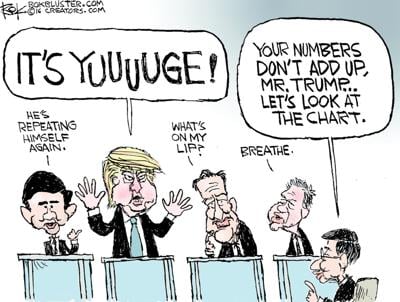
While the nation continues to marvel at what has certainly been one of the more extraordinary presidential primaries in recent memory — the GOP frontrunner hurling xenophobic and anti-immigrant rhetoric from the debate stage as he is flanked by two contenders of Cuban descent and a former secretary of state coming under a formal investigation by the FBI as a democratic socialist nips at her heels — I can’t help but point out that this is just one in a long series of bizarre and divisive moments in American politics.
Sure, contemplating the erosion of civil political discourse is a worthy exercise, and one is right to wonder how we, as a nation, went from the high ideals of Franklin Roosevelt and the New Deal to Lyndon Johnson and the Great Society to the compromise-first strategy of The Great Communicator to the low-brow enterprise of branding candidates with demonizing nicknames like “Little Marco” and mocking people for the size of their hands.
With the rise of partisan fodder machines like Fox News and MSNBC and a fractured-as-ever body politic, we may well be on the cusp of a new era — more accurately, a return to an older period — when a large swath of the country sets up camp on the right or left and abandons the center altogether.
Recall that up until the 20th century, newspapers, the main vehicle for disseminating information among different regions in the nation, usually carried the banner for one party or the other, and many publications, like Horace Greeley’s New-York Tribune, William Lloyd Garrison’s Liberator and Henry Raymond’s New York Times largely grew up around their influential editors.
In the late 18th century, Americans got their information from either Federalist newspapers — many of which published the series of essays by Alexander Hamilton, James Madison and John Jay that would be known collectively as “The Federalist Papers” — or rags touting the populist vision of the Jeffersonian Republican Party.
The latter camp would later be referred to as the Democratic-Republicans, and the party eventually evolved ideologically into the Democratic Party of the early 20th century, which was the precursor to the modern Republican Party. Federalist principles, which favored a robust central government, were embedded in what would come to be known as the Republican Party’s platform through the mid-1900s until Strom Thurmond, a 1948 Dixiecrat presidential candidate who makes Donald Trump’s brand of xenophobia look vanilla by comparison, broke camp and joined the GOP, essentially ensuring general Republican control of the South for decades.
With that backdrop, whether we wind up seating the first woman in the White House, a real estate mogul who flies loose with name-calling and even looser with facts or a Vermont senator vowing to break up the big banks and wage war on the billionaire class, this political cycle may not even register in the top 10 most contentious elections in United States history.
Consider the 1800 race pitting the incumbent President John Adams against Vice President Thomas Jefferson and Aaron Burr that took place before adoption of the 12th amendment.
At that time, members of the Electoral College got to cast two votes for president, and the person who came in first won the White House. The runner-up, regardless of political affiliation, was named vice president. In that year, Jefferson tied with Burr, while Adams came in third. Alexander Hamilton, who was already embroiled in a bitter personal dispute with Burr that would later end in his death via duel, strongly encouraged members of the House of Representatives, who were charged with breaking the tie, to support Jefferson.
Hamilton launched a “furious letter-writing campaign” to compel the Federalists to vote against Burr, according to The Gilder Lehrman Institute of American History.
“Mr. Jefferson, though too revolutionary in his notions, is yet a lover of liberty and will be desirous of something like orderly Government,” Hamilton wrote. “Mr. Burr loves nothing but himself — thinks of nothing but his own aggrandizement — and will be content with nothing short of permanent power in his own hands.”
Jefferson, of course, would go on to become the third president of the United States, and, belying his own rhetoric about limited government, personal freedom as outlined in the Declaration of Independence and the plight of the yeoman farmer, would oversee the largest land expansion in American history, would never free all of his slaves and sanctioned the military’s first covert operation to topple a regime in Tripoli and prevent pirates from capturing more American ships in northern Africa.
Hamilton would end his legendary feud with Burr at Weehawken, N.J., as the sitting vice president of the United States shot and fatally wounded America’s first treasury secretary.
Of course, who could forget the contested race of 2000 between George W. Bush and Al Gore and their infamous hanging chads, the election between Abraham Lincoln and Stephen Douglas that sparked the Civil War and the four-way Democratic-Republican free for all from 1824?
Perhaps the most controversial and consequential election cycles came in 1876 when Republican Rutherford B. Hayes defeated Democrat Samuel J. Tilden on little more than a handshake.
As hard to believe as it is, details about the so-called Compromise of 1877 are sketchy at best, but according to Smithsonian magazine, the fate of the White House hinged on 20 electoral votes from the contested states of South Carolina, Florida and Louisiana.
“Throughout the campaign, Tilden’s opposition had called him everything from a briber to a thief to a drunken syphilitic,” according to the magazine. “Suspicion of voter fraud in Republican-controlled states was rampant, and heavily armed and marauding white supremacist Democrats had canvassed the South, preventing countless blacks from voting.”
As part of the deal, Hayes, in exchange for the presidency, agreed to pull federal troops out of the region, which signaled the death knell for Reconstruction and handed the South to the white supremacists. Or, as Frederick Douglass acidly described it, black folks were given back over to the “rage of our infuriated former masters.”
“As a result, the 1876 presidential election provided the foundation for America’s political landscape, as well as race relations, for the next 100 years,” according to Smithsonian.
For all his bluster, I don’t actually think Trump is openly hostile toward Mexican immigrants, Syrian refugees and other groups that he has denigrated these last 10 months. He’s simply a genius at marketing his own brand, and he has figured out — or perhaps knew before entering the race —that he could garner votes by tapping into real fear and anger a certain segment of the population is feeling about the government, the economy or society at large.
The disturbing thing about this presidential election is that he has found such a large, captive audience among those who, apparently would if they could, set the nation back generations.


