


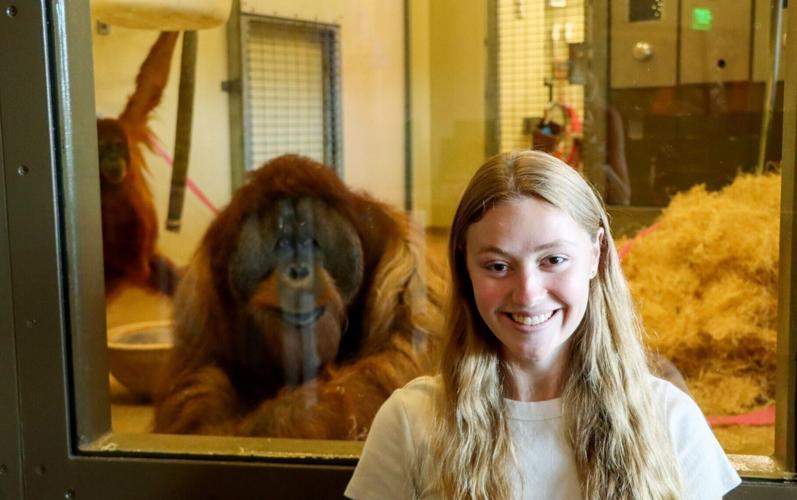

Some of the Cartmill lab’s work takes place at the Indianapolis Zoo. IU Ph.D. student Emma Nelson, above, conducted part of the laughter research on one of the zoo’s orangutans while completing a research internship there. (Courtesy of Indianapolis Zoo via SWNS)
By Stephen Beech
Hearing laughter helps orangutans to learn, reveals new research.
Being in a positive mood leads the primates to value what they learned more strongly, according to the findings.
Scientists have long acknowledged that in humans, positive moods enhance learning and make experiences more memorable.
But the evolutionary origins of the trait hadn’t previously been studied in other great ape species.
Researchers at Indiana University in the United States theorized that if orangutans heard laughter while learning how to find a reward, they might value that reward more.

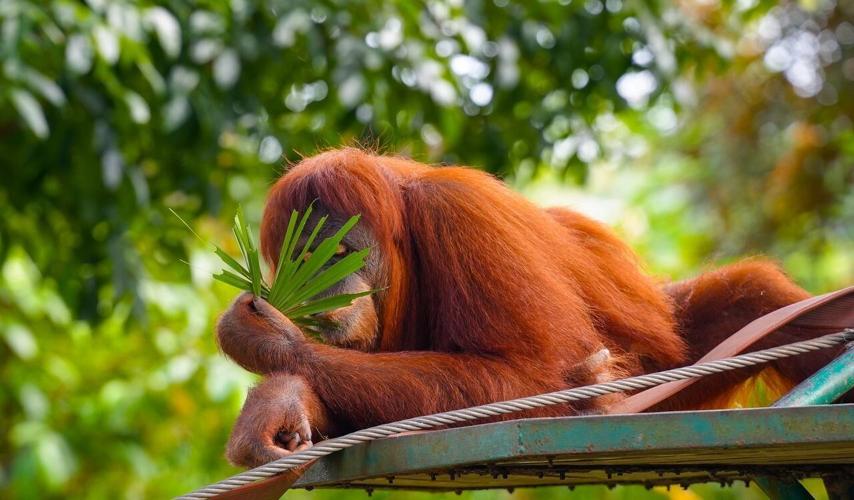
(Photo by Ian Gabaraev via Pexels)
They designed a study that took place over five consecutive days to test the hypothesis.
For the research, published in the journal Biology Letters, orangutans were presented with two bowls containing different materials they had to dig through to find a food reward.
On days one and three, food was always hidden under one material, for example wood chips, and never under the other, such as paper towels.
On the second and fourth day, the same unrewarded material was presented, alongside a new material, such as yarn, that now covered the reward.
On the fifth day, the research team brought back the two materials that had previously hidden rewards to see which one the orangutans preferred.
The primates had learned that food rewards were hidden under both wood chips and yarn, so they shouldn’t prefer one over the other when looking for the reward.

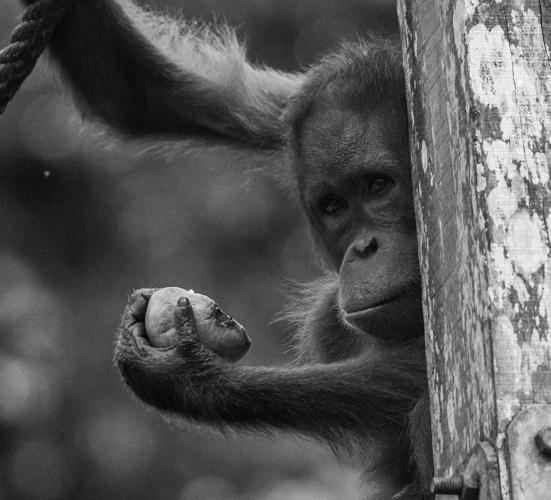
(Photo by G N via Pexels)
However, the important difference was that the researchers had played the sound of orangutan laughter when the orangutans were searching in one material, and a control sound when the orangutans were searching in the other.
When given a choice between both hiding places, orangutans preferred the material that they dug through when listening to laughter.
The researchers said that because laughter is contagious for all great ape species, it can impact mood positively.
They concluded that hearing laughter puts orangutans in a more positive mood and causes them to value a reward more.
Study lead author Daan Laméris, who conducted the majority of the study at Zoo Planckendael wildlife park in Belgium, said: “It is surprising to find these effects with orangutans, because they are the least social of all the great apes.

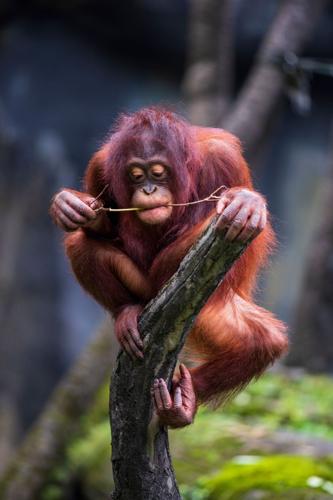
(Photo by Klub Boks via Pexels)
“So even among relatively non-social animals, laughter is important.”
Senior author Erica Cartmill likens the findings to something that happens with humans.
She said: “You might like your grandma’s pancakes the best not because they are objectively the greatest pancakes ever made, but because you have positive associations with eating that food at a loved one’s house.
“What we’ve shown in this study is that we can measure the value of laughter, and we can measure how much mood is valued.
“When you’re in a better mood, the memories you form are remembered more positively and have more value to you.”
Cartmill wanted to study positive emotions such as joy in animals because she said the scientific scales tend to be tipped toward studying fear, grief and loss in animals, contributing to a narrative that nonhuman animal life is only about competition and survival.
She added: “Part of this project was to ask, ‘What are the moments that help shape the lives of the animals we share a planet with?’
“It isn’t just about surviving to reproduce, but it’s actually about creating a narrative that also involves friendships and memories and building toward the things that give life meaning.”


