



(ESA/GCP/UPV/EHU Bilbao via SWNS)
By Dean Murray
Space scientists have said that Mars' "oddest cloud" may be even odder than they thought.
Researchers using the European Space Agency's Mars Express spacecraft, alongside a state-of-the-art meteorological model, have found that there may be some very "exotic physics" behind the planet's "most curious cloud."
A study published in Nature Geoscience suggests that the Arsia Mons Elongated Cloud (AMEC) forms through homogeneous ice nucleation – a process in which water vapor turns directly into icy cloud particles without first condensing on dust or other material.
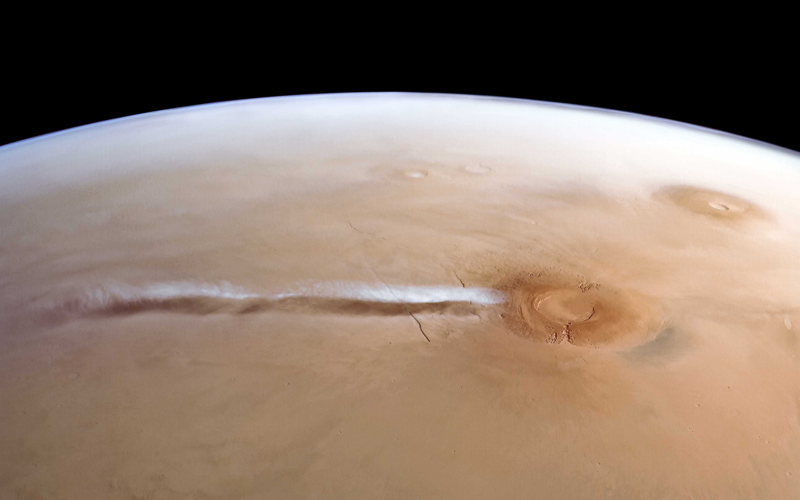
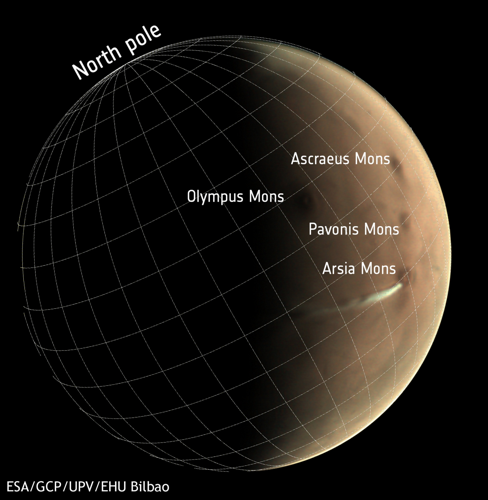
Mars' "most visually striking cloud" – which is up to 1,800 km long, nearly twice the length of the UK – appears every spring and summer in Mars' southern hemisphere, during the Martian dusty season.
The white wisp of water ice emerges downwind of the 20-km-tall Arsia Mons volcano. It forms, grows and fades each day, stretching out before quickly evaporating. This cycle repeats every morning for several months.
The study suggests the cloud forms when winds over Arsia Mons rapidly lift moist air, cooling it so much that water vapor freezes directly into ice particles without dust or other condensation nuclei.

(ESA/DLR/FU Berlin via SWNS)
Jorge Hernández-Bernal of LMD/CNRS/Sorbonne Université in Paris, France, lead author of the new study, said: "To create the AMEC in our modeling, we found that we needed to include some exotic physics, physics that, while included in textbooks, is treated as theoretical and usually thought not to happen in nature. It certainly hasn't been seen in action before. Once we included this physics in our simulations, the AMEC emerged just as we hoped."
As winds flow past Arsia Mons, the volcano's bulk triggers a powerful wave that lifts moist parcels of air several kilometers up in just a few minutes. This cools the atmosphere rapidly, causing temperatures to drop by 30 degrees in just 10 minutes and relative humidity levels to spike. Water vapor then spontaneously freezes directly into cloud particles, forming the AMEC.
While some aspects of the modeled cloud don't exactly match the observations, "the result is remarkable," says Jorge. "We don't have nearly as much information about Mars's atmosphere as we do about Earth's, so reproducing the AMEC to this degree is a big success for the model."
Beyond furthering our understanding of atmospheric processes on Mars and elsewhere, the result highlights that we should not discount unlikely processes when exploring the planets of the universe (including exoplanets).
ESA Mars Express Project Scientist Colin Wilson said: "While clouds on Earth and Mars seem to be governed by the same 'rules', understanding this exotic martian cloud required exotic physics – and this may be true elsewhere in the cosmos."

