


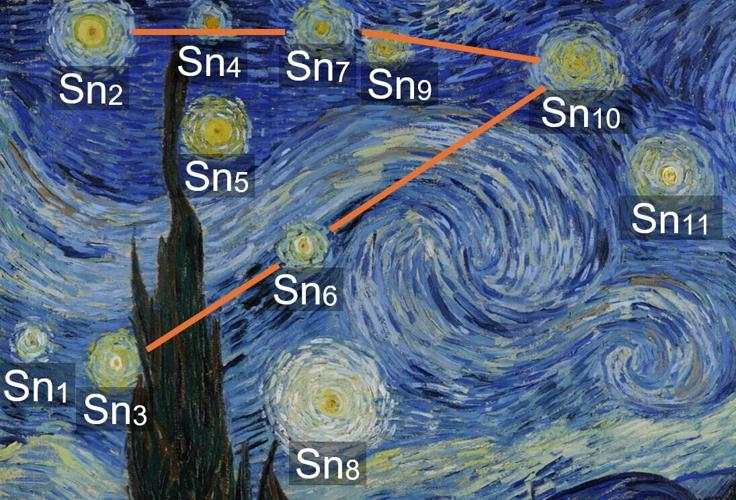
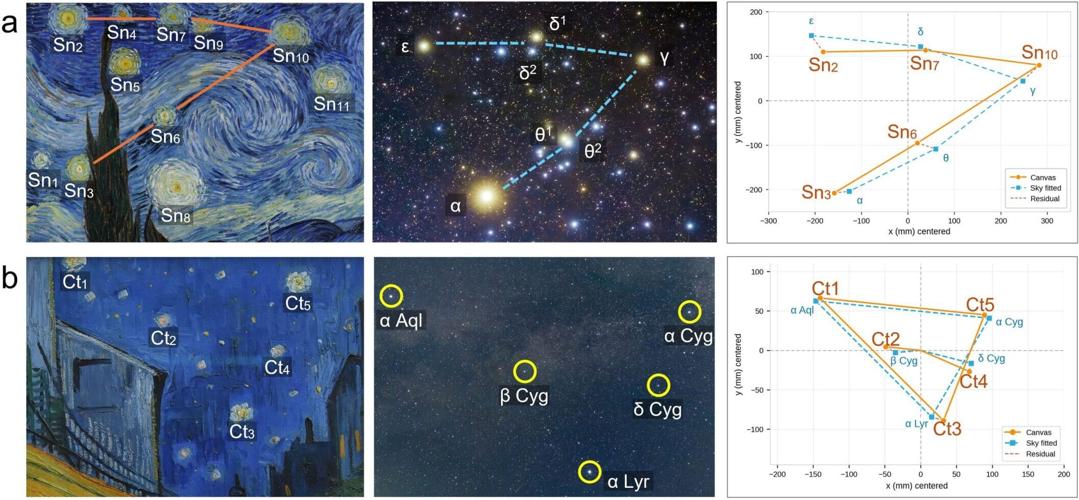

a) The central cluster of stars in The Starry Night (1889), left, and the Hyades cluster in Taurus, center. At right, the five stars in the painting (orange) are overlaid on the real stars (blue) after matching for size, orientation and position; red dashed lines show the residual differences. (b) The stars in Café Terrace at Night (1888), left, and the stars around the Summer Triangle, center. The panel at right follows the same layout as in (a). (Kim et al. via SWNS)
By Stephen Beech
Vincent van Gogh’s “The Starry Night” sky matches that of a date in July 1889, according to new research.
The iconic painting has conventionally been dated from a letter the artist wrote to his brother, Theo, around June 18 that year.
But experts say the waning gibbous moon of that period can’t account for the slender crescent in the painting.
A new study, published in the journal Scientific Reports, finds that the sky in the painting matches, in both observation and shape, the predawn sky over Van Gogh’s then home in Saint-Remy, France, around July 22, 1889.
It featured a waning crescent moon, Venus and the Hyades star cluster — all within the painter’s field of view, according to the first astronomical re-examination of the painting in four decades.
The study was conducted jointly by space-science company SLLAB and the School of Space Research at Kyung Hee University in South Korea.

Kevin Snow
Astronomical readings of “The Starry Night” began with American scientists Albert Boime, in 1984, and Charles Whitney in 1986.
But, because the two reached conflicting conclusions, neither displaced the prevailing religious and symbolic interpretations of the painting.
In the 40 years since, no study has treated the painting’s sky with observational geometry.
Study first author Elijah Jeong-hyun Kim said: “To an observational astronomer, the cluster of stars in ‘The Starry Night’ is the Hyades in Taurus.
“But the moment I read the earlier studies explaining it as Aries, I heard the painting calling to me.”
Having built several telescopes and spent years observing the night sky, the Korean team judged Aries an unlikely source of inspiration for the painter.
The research began with two field trips to France in 2019 and builds on a book by Kim, published in 2025, gathering additional evidence and extending it with quantitative data.

(a) The central cluster of stars in The Starry Night (1889), left, and the Hyades cluster in Taurus, center. At right, the five stars in the painting (orange) are overlaid on the real stars (blue) after matching for size, orientation and position; red dashed lines show the residual differences. (b) The stars in Café Terrace at Night (1888), left, and the stars around the Summer Triangle, center. The panel at right follows the same layout as in (a). (Kim et al. via SWNS)
He said that around July 22, 1889, the Hyades rose in the east alongside Venus, and the moon’s shape was close to the crescent on the canvas.
But that date has long been assumed to fall within one of Van Gogh’s seizures.
By cross-analyzing the original French and Dutch letters, contemporary weather records and the letters’ remarks on cicadas, the research team proposes that the seizure began in late July.
In Arles, the team verified the painter’s field of view in “Starry Night Over the Rhone,” from 1888, with photographs taken on site.
In Saint-Remy, they located the spot from which Van Gogh drew the landscape beneath “The Starry Night” and reconstructed his view from there.

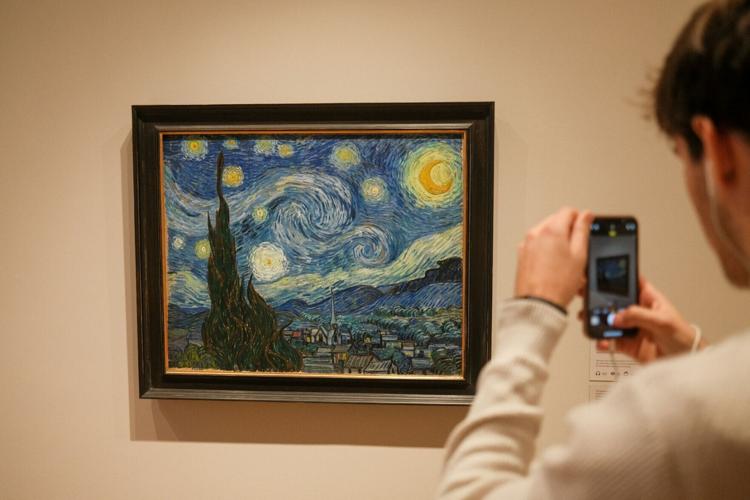
(Photo by Douglas Schneiders via Pexels)
Procrustes shape analysis, a statistical method for comparing and aligning shapes, then confirmed the correspondence between the five central stars of “The Starry Night” and the Hyades, with an even closer match in the pen drawing Van Gogh made after the painting.
The researchers say their results suggest that the sky in the painting was grounded in actual observation rather than pure imagination.
Using the same method, the team also proposes that the stars in Van Gogh’s 1888 painting “Cafe Terrace at Night” may be the Summer Triangle.
Kim, CEO of SLLAB and a doctoral candidate at Kyung Hee University, said: “I hope this work prompts a renewed, multidisciplinary look at the sequence and working methods of the Saint-Remy paintings, and at Van Gogh’s movements that summer.”
He added: “Our conversation with Van Gogh’s other skies is still ongoing.
“We plan to tell those stories one by one.”


