


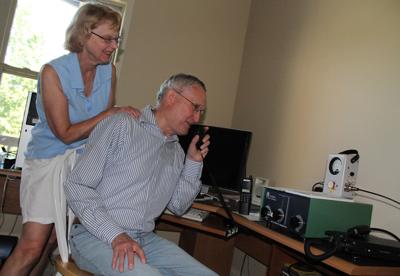
While still a relatively new group in Tellico Village, the Tellico Lake Amateur Radio Club and its members are hoping to find like-minded radio enthusiasts to get together, talk about equipment and share the airwaves.
The club was established near the first of the year, club president Allan Tarbell said. Currently, the club has about 20 members not including spouses and loved ones. Of that total, about two-thirds of the group is from Tellico Village. Radio operators from Loudon and other counties in East Tennessee also participate in the club.
Brad Berger, club vice president, said TLARC’s first intent was to get people licensed and see what kind of interest there was in the hobby.
“Typical amateurs, you know, you go through cycles in life where you’re active and you’re not,” Tarbell said. “Sometimes family and job and everything takes over, and then you retire as both Brad and I and Joyce (Tarbell, wife and club secretary) are and then you go, ‘Hey, maybe I should go back,’ and you do. So that was kind of that thing to find out who’s around that might be active or inactive and see if we could get folks together.”
After a quick search through the Federal Communications Commission database, Allan Tarbell found out there were about 125 “hams” in Loudon County, and about 50 of them were located in Tellico Village.
“My goal was to kind of find out who were the hams and draw them out and see who’s active and get folks active again, including myself, because I had been inactive for awhile,” Allan said. “The basic goal is to have a good time. I mean, if you enjoy — there’s technical aspects of the hobby — building, operating, that kind of stuff. There’s the social aspects, the club meetings, the activities like field day which are technical, operational but also fellowship social type things.”
Berger said he believes the club’s overall goal is to support the hobby of amateur radio and educate beginners to help them get their license. Berger re-obtained his license late last year after joining the club. Previously, he had an interest in electronics but never followed through with renewing his license when he was a kid, he said.
“My whole career has been in radio communications,” Berger said. “I just like the technology ... and meeting the people that also share that interest. ... Allan and other more experienced hams taught classes. We had a class of maybe a dozen people, multiple classes and through that we took our test and all get licenses.”
Basic study materials for passing an FCC initial license test typically cost no more than $40, according to the National Association for Amateur Radio.
“The FCC has turned over to amateurs the actual licensing with testing,” Allan said. “In other words they have what we call volunteer examiners, and we have a volunteer examiner coordinator in the area. So if we have a bunch of hams who want to test, we’ll give them the test. I’m a volunteer examiner. They take the test, we score it and then we forward it to the coordinator who then signs off on it and has computer access to the FCC database. He enters that information. The FCC then takes that data, and I think they make checks for if the person has a felony conviction and that kind of stuff.”
How expensive the hobby becomes is up to the hobbyist, Allan said, noting a simple handheld radio may cost as little as $28.
“I would say the typical amateur station is probably several hundred dollars, probably not over $1,000,” Allan said. “Although, there are some that have put over $1 million into their stations, I mean, in towers and antennas, electrical. I mean, you can go from almost zero to six or seven figures.”
Purchasing equipment to talk with other radio operators from across the nation on what Allan called a “reasonable station” would cost about $500, he said.
Ham radios are useful during emergency situations when local infrastructure is potentially damaged, Berger said.
“Imagine there’s an emergency in Loudon County, and we know an ice storm can do a lot of damage to the local infrastructure for example, and what do we do?” Allan said. “OK, well, we have to have the antennas available. We have to get them up. We have to get a generator. We’re running on emergency power. We’re running on generator power. We have to have equipment. We have to know how to use it. We have to know who has what and can do what.”
A radio repeater is placed on the water tank off Chota Road that can help reach another miles apart, Allan said, noting that the Tellico Village Property Owners Association has been helpful with the club’s activities. Recently, TLARC partnered up with Monroe Amateur Radio Club and more than 35,000 radio enthusiasts across the United States and Canada to participate in the American Radio Relay League Field Day, in which operators practiced for emergencies and took part in an informal contest. Radios were manned for 24 hours, with the goal of reaching as many other field day participants as possible.
More than 300 contacts were made in 48 states and several countries, according to a TLARC press release.
“The point is again if it’s an emergency sort of thing and it was more than just local, regional, this is the way people would operate,” Allan said. “We probably talked to over 300 stations across almost all the states and several countries.”
The local radio club in Tellico Village meets at 7 p.m. the third Wednesday of the month at Chota Recreation Center. Annual dues are $12 per family. For more information on the club, call Joyce Tarbell at 865-458-8040.
“We have some women in our club, and we’re trying to get more women involved,” Joyce said.


