


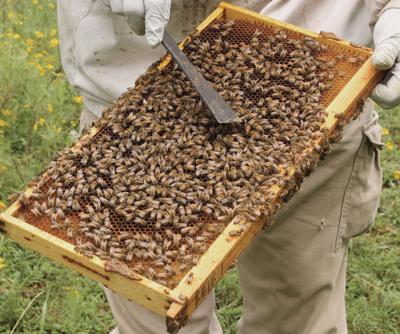
With the honeybee population decreasing at an alarming rate, local beekeepers and gardeners agree pesticides may play a part in the declining population and that food sources may become limited if the trend continues.
“I think there’s a lot of different things contributing to the colony collapse,” Lisa Grugin, manager of Meadow View Greenhouses and Garden Center in Lenoir City, said. “Insecticides undoubtedly play a part in that. You have to be smart about it.”
The best times for spraying insecticides include early morning before 7 a.m. and after 7 p.m., Grugin said.
“What we try to do here is we try to educate the consumer about the product they’re using,” Grugin said. “Not to do it when the bee is active. Usually, you want to wait until the bees go to their hives at night.”
To control insects, Grugin recommended customers start with the least toxic insecticide possible, such as an insecticidal soap solution. Grugin said most of the soaps are premade with dishwashing detergent to kill flying insects. Insecticidal soaps may be used with organic farming, she said.
Although most people come into the garden center and want to buy the strongest insecticide possible, she said using a harsh chemical is not necessary most of the time. Another option to control insects is using a water-soluble systemic insecticide, Grugin said.
“There’s a lot of discussion whether it’s contributing to the bee collapse or not,” Grugin said. “Companies tell you it doesn’t harm the bees because it does not get into the pollen. There are things to do to use insecticides responsibly.”
John Goddard, agent with the University of Tennessee Agriculture Extension office, said there is no one concrete reason for the decline of honeybees.
“For example, if you get the flu, that might lead to pneumonia,” Goddard said. “It’s kind of a combination of things.”
People think that cellphones contribute to the decline of honeybees with the different signals sent off. Goddard said he isn’t sure research supports the theory.
Other experts think the declining population may be attributed to less crop growth, fewer food sources and less pollen, he said. With developers clearing land to make parking lots and streets, agricultural production is declining as honeybees have fewer food sources.
“When I came down here 27 years ago, there was maybe 50 members who were beekeepers,” Goddard said. “Now we’re down to just a handful of beekeepers.”
Mites may also get into the hives and destroy the honeybees, Goddard said. Weather may be another influence.
“I think it’s just a combination of all of these things,” Goddard said.
He said he does blame insecticides on the honeybee population decrease, pointing to the U.S. Food and Drug Administration recently strengthening standards and restrictions.
“Now they have to have a commercial applicator or a private applicator’s license or a certificate where they have to be trained before they can purchase that,” Goddard said.
Lenoir City beekeeper Richard Bailey said he believes pesticides have been a major factor.
“During the last six to seven years, we’ve had a tremendous decline,” Bailey said. “We can’t keep losing 60 percent of our bees.”
Bailey said homeowners often buy pesticides without reading labels and spray at incorrect times during the day.
“It’s not just honeybees that we’re losing, it’s all of our pollinators,” Bailey said. “All of our pollinators are crashing.”
As poison spreads around the hive through the use of insecticides, honeybees have difficulty maintaining a livable temperature in the hive, he said. Bees typically gather into a cluster during winter to move their wing muscles and raise heat, Bailey said.
“If we keep losing our pollinators, the price of fruits and vegetables is going to go higher,” Bailey said. “That’s why we need to get a handle on it now. We can’t keep losing bees at the rate we’ve been losing bees.”
According to the USDA, one out of every three bites of food in today’s diet is pollinated by honeybees.
“I don’t know that you can point at one thing and say that is the problem,” Bailey said.


