


In the past year, the Tennessee Bluebird Society chapter in Tellico Village has saved the lives of many native species and plans to educate the public this coming year in hopes of making conservation more relevant to younger generations.
Village resident and founder of the Tennessee chapter, Chuck James, became involved with the North American Bluebird Society several years ago before moving to Tennessee.
He said he was surprised to find that Tennessee had no state chapter, and since creating the organization about a year and a half ago, 90 members have joined to assist in the conservation of not only bluebirds, but all native North American species.
“For me, I love conservation,” James said. “... If we don’t keep vigilant in trying to protect some of our native species, we’re going to lose them, and even though the bluebird has made a recovery somewhat, it’s at about 60 percent of where it was in the late 1800s. If we don’t continue to be vigilant, we will go backwards and possibly lose that species.”
James said the bluebird population began struggling to survive in the late 1800s when the English house sparrow was imported to North America as a means of ridding farmlands of insects. The sparrows stole nesting cavities from bluebirds, but those weren’t the only competitive species attacking natives.
James said the sparrow and starlings, also imported from Europe and Asia, both kill bluebirds and steal their nests.
By the early 1970s, the bluebird population fell to 10 percent of what it was in the late 1800s, and while the population currently is at 60 percent of what it was in the 1800s, the species remains at risk, James said.
“Bluebirds, like with many species of animals, about 80 percent of those that fledge during any given season like that last summer do not make it to this coming summer,” James said.
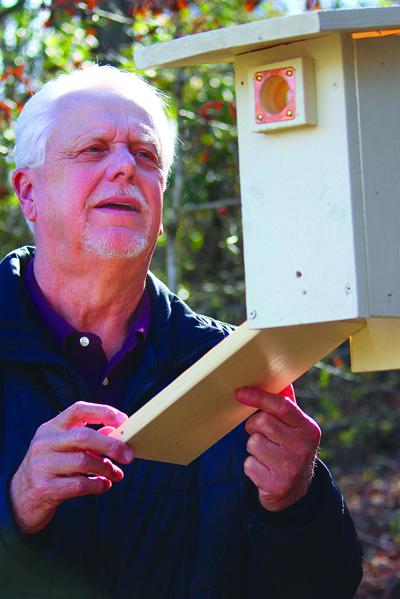
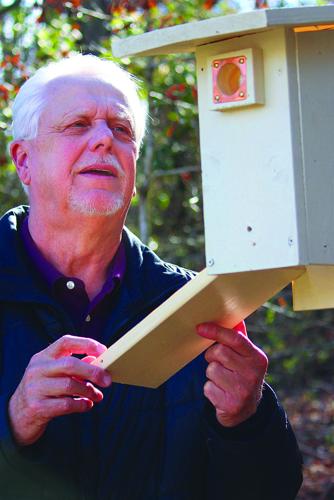
The Tellico Village chapter of the society continues to place nesting boxes in various locations throughout the community to help lower the species’ high mortality rate.
With the help of the Village Birders club, James and Stanley Colburn will have placed about 100 nest boxes in the Village by springtime.
The houses have been primarily built by Colburn and volunteers with the Tellico Village Woodworkers Club.
Bluebird houses have been spread across the Toqua and Tanasi golf courses, the Community Church at Tellico Village campus, the grounds at the Yacht Club and on The Public Library at Tellico Village property.
The group plans to add nest boxes to the area surrounding the First Baptist Church of Tellico Village this spring, James said.
“If you put up a nest box, that’s great,” James said. “We encourage people to put up bluebird houses, nest boxes, whatever you want to call it. But they really should monitor them to make sure that ...”
“You just can’t put them up and walk away from it,” Colburn continued.
James said Tennessee is fortunate because bluebirds do not migrate south for the winter. Birders feed them each morning and make sure their water stays fresh.
After the birds nest each cycle, organization members clean the boxes and prepare them for the next incoming family, James said.
Colburn said other native species utilize nesting boxes as well, including chickadees, tufted titmouses and Carolina wrens. The organization cares about all native species, but the bluebird name is more recognizable to the public.
“It’s a way for conservation,” Colburn said. “It’s a way to get the word out that you always have to be vigilant. You have to be a good steward of the land. You really need to keep pushing that with other generations. A lot of people recognize the bluebird. They know what that is. It’s always like a sign of spring and brings smiles to people’s faces. It’s like the keystone. It’s like the flagship of birds, and of course, we’re helping all cavity nesters.”
James and Colburn agreed the next step is not just to continue building nesting homes for native birds, but to educate the community on the importance of conservation.
Colburn said building birdhouses would be a “great” family project, and the target group for education should be younger generations.
James said the organization encourages people to join the organization, which costs $15 annually. James said anyone in the state may join, and applications can be found on the society’s website at http://www.tnbluebirdsociety.org.
“It’s been very rewarding because there are few things in nature that you as an individual can have an impact on,” James said. “By putting out a nest box in the spring and watching, you know you’ve done that. You’ve put out that little home that that bird can find and raise a family, and when you watch bluebirds they’re a lot of fun because each of them has their own little personalities, and they’re all little characters.”
“All these populations are very fragile, and if we don’t keep after them and monitor them and try to protect them, when something happens to a population, we need to jump in there and try to get it back up and running, you know,” Colburn said. “... It’s going to cost you a whole lot more money to save a few individuals than it is to try to keep the population stable.”


