


By utilizing a set of diver gear, both new and old, the recently formed Loudon County Marine Rescue Unit is hoping it will be prepared for any situation that occurs on area waterways.
The volunteer diver rescue unit merged with Loudon County Emergency Management Agency earlier this year after Loudon County Commission voted unanimously to allow the transition.
“We only run 10-15 calls a year, but we were going out and we were seeking our funding every year,” Capt. Chad Walters, with the dive team, said. “We were maintaining all of our own books. We were maintaining all of our own wield assets, water assets, and it just made more sense to merge with another agency that already had all of these assets, merge all of our gear and you utilize basically one admin staff.”
Walters said the merger with EMA would help make the job a little easier to manage. The volunteer dive team consists of four officers, including Walters as chief, an assistant chief and a training and equipment officer. Team members share equipment with the emergency management office.
EMA Director Daryl Smith said he thought he could help with the office work necessary for operation. Letting Walters remain as the head of the dive rescue unit was just a “natural fit,” Smith said.
“They were in the process of trying to buy a boat, that’s what they were trying to do, and after we acquired this (boat) from a military surplus program, then Chief Walters with the dive team came to me and said that he thought it would be a perfect fit,” Smith said.
Merging also helped with funding, which Walters said the unit had been doing on its own. On average, the crew needs about $12,000 to operate each year. The county contributed $4,000 from the general fund, Smith said.
“With all the water recreation we have in the county, I think it was definitely a need for it,” Rollen “Buddy” Bradshaw, county mayor, said. “Absorbing it, it was just a no-brainer, especially because there’s no front end cost on it. We don’t have to worry about buying all the equipment. So I think it’s just a great opportunity, and Capt. Walters is still in charge of it.”
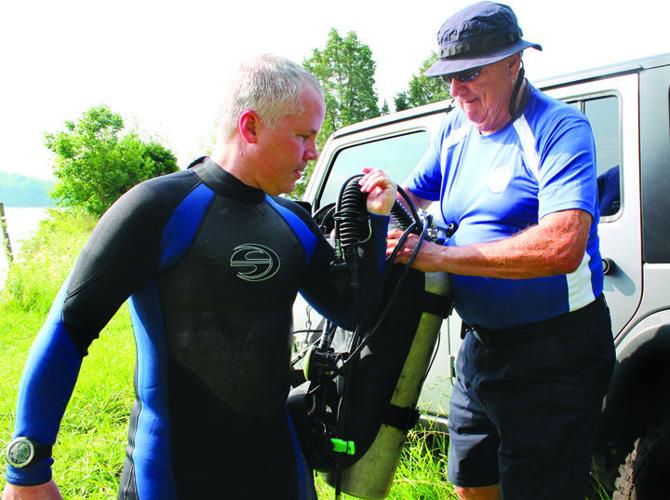
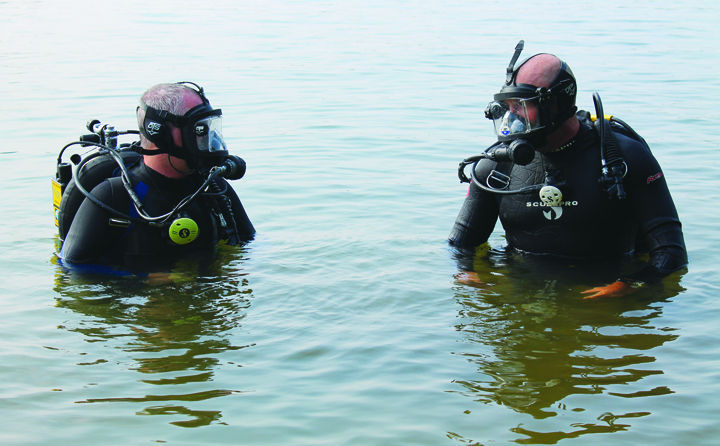
On Saturday, the crew tested new communications gear, which included one microphone for each diver, along with an Aquacom box on the bank for an overseer to communicate with those underwater at all times.
“This right here is the transmitter, basically the antenna that goes into the water,” Richard Brown, marine rescue unit member, said. “Each one of those guys has a transmitter receiver on their gear packs, and that is plugged into the full face mask. They’ve got receivers on top. They’ve got a push-to-talk, basically a mic inside their mask. They push it and they can talk to us.”
Brown said the divers have two ways of communicating with the new gear, either by utilizing a push-to-talk mechanic or just simply setting the microphones to voice activated.
The new gear replaces an old system of rope pulling, Smith said.
“All we’re trying to do with the comm gear is just increase diver safety and just make it just a little bit more efficient underwater,” Walters said. “Typically what we do, and we still — if we’re out here looking for a victim, a firearm that’s been thrown in the water for evidence or whatever, we work on a rope, a tender line, and tender stands on the bank, and they work the diver in an arc pattern.”
Walters said the new equipment ran $3,000 per diver, and the box, which is utilized by an overseer on the bank or boat, cost $2,000. The team can accommodate three divers using the new equipment, he said. Purchases were made through the dive team’s budget.
“It’s a great tool. It justifies the expense,” Walters said.
The new gear has the capability to work about three miles of open water away from the transmitter on the bank, Walters said.
The vessel the dive team utilizes is a 32-foot, $10,000 boat EMA officials purchased from a military surplus in North Carolina nearly three years ago. Smith said the boat has the ability to go 50 mph and has been used during both Rockin’ the Docks events in Lenoir City. The boat will also make an appearance at the city of Loudon’s Riverfest in August.
“We’re limited in, at this point, how much time we actually take the vessel and just come out and do safety patrol,” Smith said. “You’re limited based on your fuel budget. That’s the only thing we’re limited to. We have no overhead costs with employees or anything because everybody’s a volunteer that’s out here.”
Included on the boat is a depth finder, chart plotters, radar and an infrared camera, Smith said.
“Anything that’s got a temperature difference than the surrounding ambient area, including the water, it’s going to show up on there,” Smith said about the infrared camera, which swivels 360 degrees. “We can see a person in the water a quarter of a mile. ... It will see a vessel in the water at 2,500 feet, basically a half mile.”
Most of the devices installed in the boat were placed after it was purchased. Smith said a new radar, chart plotter and infrared camera system were afforded by a no-match grant over the span of two years. The infrared camera and the three-dimensional chart plotter were installed in the spring. All of the gadgets the boat has are meant to provide safety for visitors, residents and employees, he said.
“This boat when it’s on the water is the safety patrol, that’s what it’s here for,” Smith said. “We staff this vessel with divers, paramedics and firefighters on every trip we make out.”
Smith emphasized that all of the people who are part of the dive rescue team are volunteers.
“All these people are donating their time to Loudon County to put this boat in play and make it an asset for the community and enhance the safety of all the people, the visitors and our residents that work on operate on the lake, and that includes people working on the water as well,” Smith said.


