


For the better part of two decades, Wes Hibbert has fostered a love for Native American history in hopes of shining a light on a topic he believes is not discussed enough.
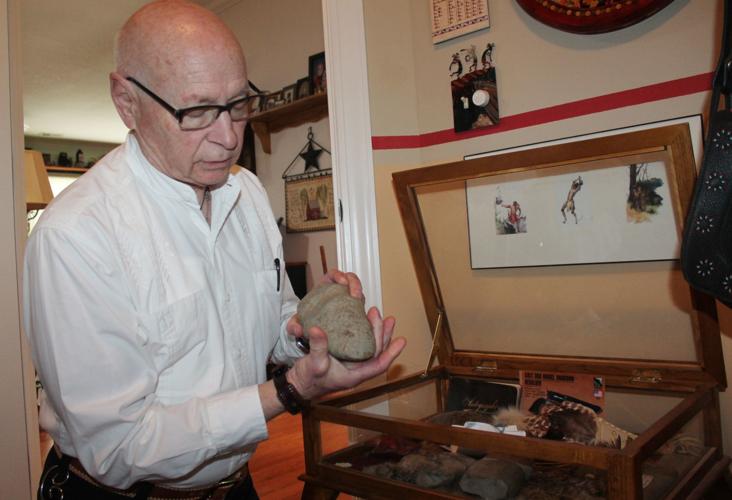
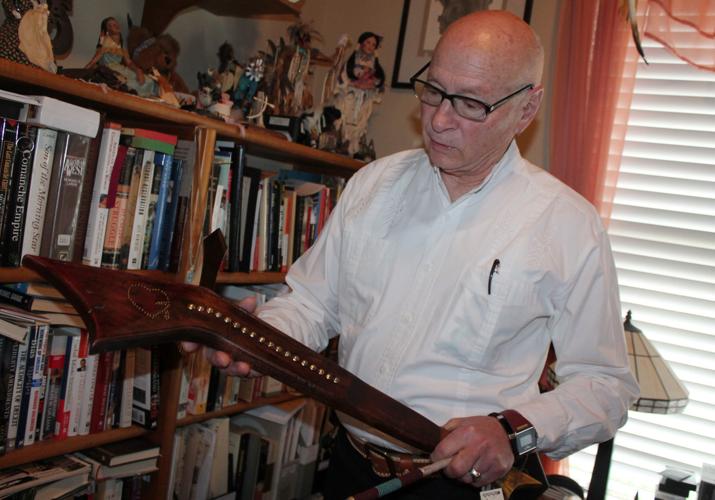
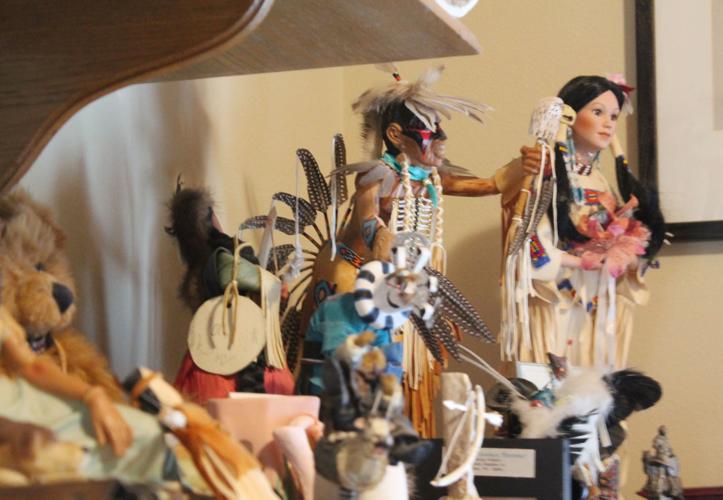
His study is filled with Native American memorabilia, including figurines, weapons and tools, and there are times he gives presentations in the community.
Hibbert’s love for history dates to his time as a child watching “The Lone Ranger,” one of his favorite television shows growing up.
“But it didn’t take me long to notice that Tonto did all the dangerous work,” Hibbert said. “He was the one that went to town and mingled with the guys at the bar and picked up information and all that stuff while the Lone Ranger just sat at camp drinking coffee and waiting for him to return.”
Older westerns in Hollywood are “bologna from start to finish” because they always portray Native Americans as the villain, he said.
“They surround the wagon, train, they burn out the farm, they kidnap people and take them back, and I had a collection of figures of Native Americans — typical ones. They’re shooting, they’re warriors and they’re in that mode, but they had a domestic life,” Hibbert said. “They got married. They raised children. They are people just like you and I. I don’t know if you ever saw that in a movie made by Hollywood until fairly recently.
“I mean they were just always portrayed as the bad guy, and you’ve got to think there’s another side that’s not being told,” he added. “It’s always intrigued me why aren’t we telling the stories of their domestic life?”
He pointed toward his collection on a bookshelf showing figurines of a bride and a woman at a loom.
“The women farmed, the men were the ones that traveled,” he said. “... It wasn’t easy to find a peaceful Indian doing anything. The warrior here is what you find. That other side didn’t get told.”
That’s where Hibbert has stepped in, with hopes of clarifying any stereotypes of Native Americans. He began giving presentations in the early 2000s while living in New Jersey, and that carried over after he moved to Tennessee. He has been a resident of Tellico Village since 2008.
“Probably the biggest interest here in this part of the country is the Cherokee because we’re living on land that used to be occupied by the Cherokee,” he said. “The biggest story that people know of in the Cherokee is either the syllabary that Sequoyah invented, or the removals.”
He spoke last year during a two-part presentation at The Public Library at Tellico Village on the Native American removal in the 19th century. The first part dealt with the legal aspects at the time, while the second focused on the removal itself, known as the Trail of Tears.
The United States rapidly expanded into the southern portion of the country where the Cherokee, Creek, Choctaw, Chicasaw and Seminole nations lived. President Andrew Jackson was instrumental in the removal. According to PBS, by 1837 the Jackson administration had relocated 46,000 Native Americans from east of the Mississippi and later secured treaties that led to removal of a larger number.
“I was amazed that there was that much interest, but I was thrilled at the same time,” Hibbert said of the library presentations. “They all went over very well, and I told the students that were there, ‘I can’t print off a study guide for you because I can’t summarize this onto a paper, but I will send you all my notes on this if you just give me your email address’.”
He pointed toward his computer that had a plethora of information on history. The document provided for attendees was 68 pages.
Hibbert has given presentations on Sitting Bull’s last stand and the first Thanksgiving, which he considered “very interesting.” At the time Massasoit, leader of the Wampanoag tribe, had a peace treaty in place with the Pilgrims, but after he died decades of peace faltered and the relationship “greatly diminished.”
“That led to King Philip’s War, and most people have not heard of King Philip’s War, let alone understand it, but King Philip’s War per capita was the bloodiest war we ever fought in this country,” he said. “... England was ready to abandon New England. Most of the Indians in New England had died mostly by European disease, but many of them were killed in battle with the Puritans.”
Native American history interests Hibbert.
“Native Americans by nature were incredibly religious, strongly religious, and that going back to the first conquistadors or the English-French explorers, the Europeans when they came over found no cathedrals, they found no churches, they found no Sabbath in the Native American culture,” he said. “The Native Americans would look at them and go, ‘Why would I do that? Why would I build a cathedral? This whole earth is godly. Why do I need a Sabbath? I follow the rules seven days a week’.”
The area is rich with history, Hibbert said, noting residents must know where to focus attention. He emphasized the Sequoyah Birthplace Museum and Fort Loudoun as two local options. About an hour’s drive to north Georgia is Chief Joseph Vann’s estate.
“Chief Vann was part European, so was his father, and they were very rich,” Hibbert said. “One of the wealthiest Cherokee chiefs in history, and he lost his entire plantation. He lost everything because he hired a white man to do some tax work for him, and that was against the law. Native Americans could not hire white people, and he did. Whether he knew he was breaking the law or not, but they just came in and confiscated his entire plantation and just threw him out of his house.”
Willard Doolittle has known Hibbert for about eight years, and although he knew about the Iroquois while living in Michigan, learning about the Cherokee since moving into Tellico Village has been much easier thanks to his friend.
“He always tries to show that there were two sides to the story, you know what I mean?” Doolittle said. “Sometimes — what Napoleon said, to the victor goes the history books. Sometimes that’s not what really happened. It’s kind of interesting. He’s taken us on trips.”
Trips have included visiting the Sequoyah museum, Chief Vann’s plantation and Fort Loudoun.
“If you haven’t been there, that is a really unique day trip,” Doolittle said of Chief Vann’s estate. “And if you get to see — the Cherokee had adopted our ways and were very ... capitalistic and they even owned slaves and all this kind of stuff and then Andrew Jackson comes around and says, ‘Hit the road, Jack.’
“... He knows his stuff and he really is very excellent about presenting it to anybody who’s interested and get a chance to listen,” Doolittle added.
Whether on the Cherokee Matrilineal Society, King Philip’s War or the Trail of Tears, Carol DeForest, library manager for The Public Library at Tellico Village, considers Hibbert’s presentations quite educational.
Hibbert will return to the library for a two-part presentation on the Trail of Tears 9:30-11:30 a.m. Sept. 10 and 13.
“Many residents of Tellico Village are very interested in history topics, especially local history and the Civil War,” DeForest said. “Wes Hibbert’s talks are in line with the mission of this library, which is education and lifelong learning. We offer regular presentations on all types of topics in addition to history, such as health issues, digital literacy, gardening, Social Security and Medicare, astronomy, just to name a few.”
For information on presentations, call Hibbert at 865-458-5658.
“I mean it’s a fascinating history, and I think we owe it to them to at least be knowledgeable,” Hibbert said.

