


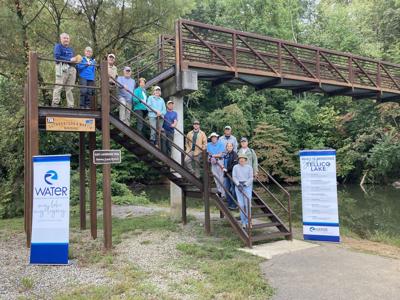
The Watershed Association of the Tellico Reservoir — or WATeR — has been quietly helping maintain and promote a clean, healthy water ecosystem in Loudon County for more than 25 years.
A watershed is all of the land that catches rain, water or snow and drains into a body of water. WATeR helps to maintain the 357 miles of land that surrounds the Tellico Reservoir, which begins at the Tellico Dam at one end of Highway 444 and ends at the Chilhowee Dam.
WATeR also helps to promote healthy water and water habits for all 15,560 acres of surface water of the Tellico Reservoir.
As the organization looks forward to a quarter century serving Loudon County, here is a synopsis of what WATeR provides to the Tellico Reservoir.
A TALL GLASS OF WATER
The Tellico Reservoir is a dammed river system. That means that without a few major riverways feeding into Tellico Lake — and maintenance from the Tellico and Chilhowee Dams — the lakeway wouldn’t exist.
With such a high surface area and hundreds of miles of watershed, WATeR steps in to fill in the gaps from local, federal and state agencies like the Tennessee Department of Environment and Conservation and the Tennessee Valley Authority … as well as the Tennessee Wildlife Resources Agency, local Soil Conservation Districts and the United States Department of Agriculture.
All agencies have the same goal in mind — to keep the watershed, water and wildlife belonging to each clean and safe.
WATeR was founded in 2000 by Bill Lenoir and Brian Baxter and recognized as a nonprofit organization in 2001. Since its origins, the organization has been composed of volunteers dedicated to protecting and improving the environment of the watershed.
Bill Waldrop, who is now the chair of WATeR’s Water Quality Improvement Committee, was one of the founding members. He had previously worked with TVA on environmental water quality issues and retired to operate his own small business — an engineering firm of only three or four people — when Lenoir approached him for help to keep Vulcan Materials from building a rock quarry in the community.
The idea of establishing the watershed was always with the intention to educate the public of best practices to protect the environment surrounding the Reservoir.
THREE MAIN COMMITTEES
Through the last 23 years, WATeR members have maintained and upheld the same objectives, adding on to their accomplishments every year. The nonprofit is made up of three main committees — Water Quality, Trails and Annual Shoreline Cleanup.
“It is a bunch of well-meaning people who bring part of their time and energies to the mission of WATeR, which is to protect and improve the environment of the watershed,” said WATeR President David Flanagan.
“If you were to go to the TDEC website, they have a mapping function, which will bring up a map of the whole state … That map will indicate three colors,” Flanagan said.
“It’ll indicate green, which means that it’s basically a waterway that hasn’t been tested and it’s probably in a state or national forest. It will indicate blue, which means that it has been tested and the quality of the water is suitable for the intended purpose. Or it will register red, which will indicate that the water quality is impaired.
“And unfortunately, if you look at the Tellico Reservoir, the color code is red for just about all of it, for different reasons, and our objective would be to make that blue,” he said.
“We would like to have this watershed to be recognized by the state and by the EPA, basically, as a clean water point.”
WATER QUALITY IMPROVEMENT
One of the main projects and committees WATeR maintains throughout the year is the water quality of the Reservoir. This includes educating the general public of maintaining water quality but also monitoring and working to increase water quality of the Reservoir.
TDEC measures the water quality of the streams in two or three locations once every five years and TVA does so at two locations every year, while WATeR tests the water multiple times a year at heavily used areas — like swimming areas and campgrounds.
WATeR works to fill in the gaps between water checks and helps to maintain a healthy ecosystem and alert agencies if an irregularity comes up.
There are three main streams that contribute to the Reservoir. Bat Creek and Fork Creek feed in from the west and Baker Creek feeds in from the east.
Each of these streams are also popular fishing spots.
Typically these streams contain high amounts of pollution in the water that contaminates the full Reservoir. Each contributes to poor water quality in their own unique ways.
Baker Creek, for instance, contains high levels of nitrogen, phosphorus and E coli bacteria from the small farms that lie on the streambed.
Agricultural pollution can come from using pesticides and other weed or bug repellent that makes its way into the creek beds and water. Most agricultural pollution comes from livestock getting in the water and either drinking from it, stomping around or using the bathroom in it.
Fecal matter heavily contributes to poor water quality and is something WATeR works diligently to improve along the Reservoir. Recently, the organization has helped to connect local farmers with resources to implement cattle watering stations, with the help of grant money and TVA, and block off streams from livestock.
“One of the services that we do to support working with the farmers is to do water quality sampling to target which areas are the main sources of the pollution so that they don’t spend their time doing something that doesn’t really count,” Waldrop said.
INVASIVE SPECIES
Other factors can be waste water being dumped into the lake or even invasive species.
Recently Hydrilla, a new kind of aquatic plant, has been found in the Tellico Reservoir. This plant grows rapidly and is considered a harmful pest. Hydrilla is originally from India, and it was introduced to the United States by Florida in the 1970s as an aquarium plant.
“One way that it got introduced is that people have aquariums, and you’ve seen all the pretty green grass growing there,” said Waldrop. “When the fish die, they flush it down the toilet.
“Another way is that some reservoirs have it, Guntersville (Lake) particularly … (If) somebody fishes there, it gets on their boat. They come up here, put their boat in and go fishing — and get sprigs of that stuff started.”
When introduced to a new environment, Hydrilla quickly takes over. WATeR is working with TVA to eradicate the species in the area.
Similarly to how new wildlife species are introduced into the Reservoir by people catching fish and releasing them in a different lake, new bacteria and algae can be introduced the same way.
It’s important to wash boats off before putting them in a new body of water, even if nearby.
Tellico Lake and Fort Loudoun Lake, while close in proximity, are distinct bodies of water and contain different species of all living organisms. Putting a boat in Tellico Lake after Fort Loudoun Lake could harm the ecosystem and potentially introduce a harmful or invasive species.
WATeR does routine water quality checks throughout the Reservoir to ensure no new species of bacteria has been introduced and, if it has, they work with TVA and TDEC to manage and find a solution.
“We’re actually working with a University of Tennessee professor to do pretty expensive but very specific DNA testing in a couple of locations so that we can identify whether the impurities are coming from cows or from dogs or from septic systems … for example,” Flanagan said.
This study has been conducted on Baker Creek and has been ongoing the past few years.
Flanagan anticipates a similar study will also be done on Bat Creek.
TRAILS
The Tellico Reservoir has 31 miles of trails on the watershed, offering plenty of dry activities to complement the lake’s water sports.
WATeR and TVA partnered in 2003 to collaborate on the now East Lakeshore Trail (ELT). When deciding to build the trail, it was never intended to be halfway done.
The trails were constructed mainly by volunteers, who installed footbridges, fence stiles, stairs, water bars, scenic view benches and navigational signs.
There are nine smaller trails that make up the ELT.
- Canal Branch (1.5 miles)
- Baker Hollow Branch (3.2 miles)
- Davis Ferry Branch (3.3 miles)
- Glendale Branch (2.8 miles plus a shortcut trail of 0.28 miles)
- Coytee Loop Branch (2.4 miles)
- Sinking Creek Branch (4.5 miles)
- Lotterdale Branch (3.8 miles)
- Jackson Bend Branch (5.1 miles plus a 0.25 connector trail to Lotterdale Campground)
- Morganton Branch (3.1 miles plus a one mile spur trail along Wildcat Ridge)
Trail volunteers contribute by either joining the work crew or by adopting a section of the trail.
Work crews are responsible for cleaning up large fallen limbs, trees and maintaining the integrity of benches, bridges and other structures.
By adopting a section of trail, volunteers commit to walk their portion of the trail at least once a month to clean up the area of smaller limbs, clear walkways, pick up trash or report any hazards.
ANNUAL SHORELINE CLEANUP
WATeR’s Annual Shoreline Cleanup is arguably one of their biggest and most important projects. Every year, at the end of March, volunteers hit the shorelines to clean up trash around the Reservoir.
On March 23, 2024, more than 250 volunteers from 23 local organizations helped to pick up over four tons of trash. While this is literally tons of trash, it is substantially less than the 2023 total of 10 tons of trash that was picked up and properly disposed of in area landfills.
“This amount is less than we have collected in previous years but is consistent with the longer-term trend of lower year-over-year collections in our cleanup event,” WATeR chairperson Tom Ringenbach said. “This, we believe, is encouraging news.”
The next Shoreline Cleanup is tentatively scheduled for Saturday, March 22, 2025. Those seeking more information can reach out to cleanup@tellicowater.org.
EDUCATION IS POWER
Education is a vital component of WATeR’s structure.
WATeR’s goal of increasing awareness is described perfectly on its website: “Through education, we strive to inform the public of threats to the fragile ecological balance between plants, animals, natural resources and man.
“We live in a very special place. The biological diversity represented in this region is second to none yet constantly threatened.”
Tennessee Smart Yards is one of the programs WATeR utilizes for educating locals, specifically those who live on the watershed. TSY is a UT Extension-led program that provides information on best lawn-care practices to not further pollute waterways.
There are nine principles of the program:
1. Right Plant, Right Place
2. Manage Soils and Mulch
3. Reduce, Reuse, Recycle
4. Water Efficiently
5. Use Fertilizer Appropriately
6. Manage Yard Pests
7. Reduce Stormwater Runoff and its Pollutants
8. Provide for Wildlife
9. Protect Water’s Edge
Those who choose to participate in the program go through a course through online modules and practical workshops taught by the UT Extension Office and water resource professionals … like WATeR members.
“We frequently make presentations to people at garden clubs and civic clubs and make people aware of the concerns,” Waldrop said. “It’s a public education-type thing, but there are a lot of manicured lawns that are over-fertilized. If you get heavy rainfall, it’s going into the lake.”
WATeR has multiple ways community members can be involved. For more information on volunteer opportunities or to learn more about what WATeR does for the Tellico Watershed, visit www.tellicowater.org.
EDITOR’S NOTE: A revised version of this story was initially published in the 2024 Summer Edition of the Loudon County Magazine. However, due to the outbreak of Hydrilla in the area and other important information that is described in this story, The News-Herald/Connection news team chose to re-publish it.

