


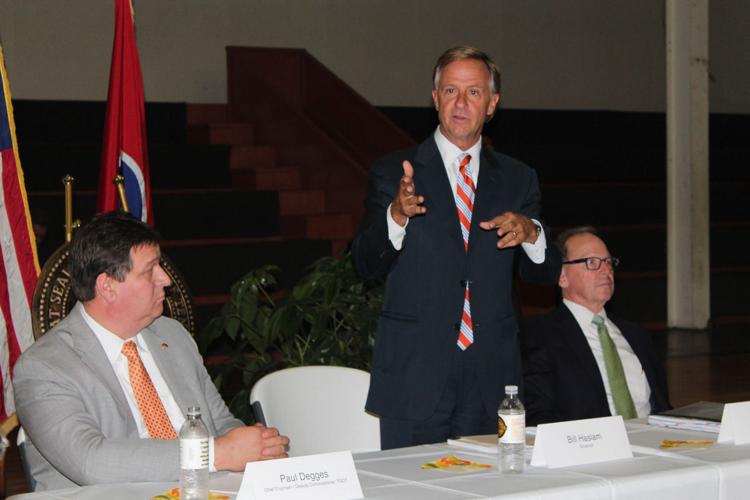
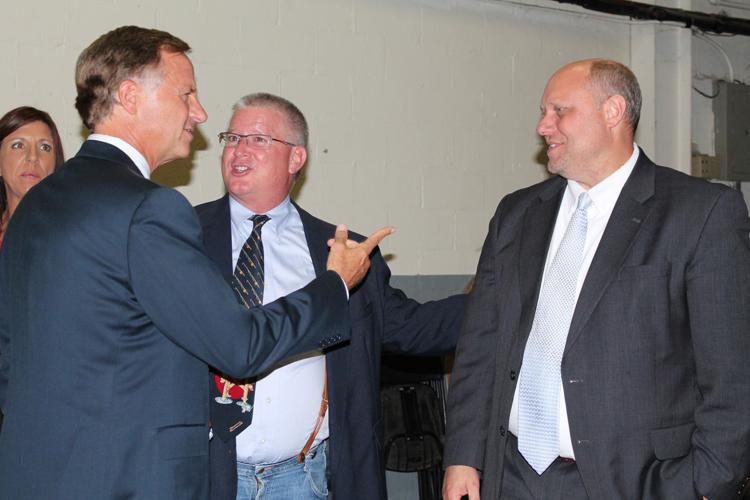
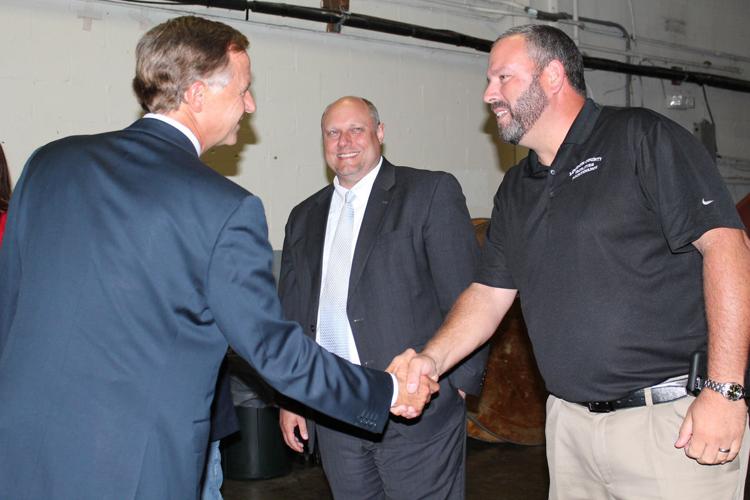
Gov. Bill Haslam and state Transportation Commissioner John Schroer visited the War Memorial Building in Lenoir City Thursday afternoon to continue their 15-stop tour to gauge the infrastructure needs of the state.
Lenoir City was the final destination of what Schroer said was a “very productive” tour around Tennessee that included stops to the major cities of Memphis, Nashville, Chattanooga, Greeneville and Knoxville.
“It’s always helpful to go and listen ...,” Haslam told the audience of more than 100 who stayed after a Committee of 100 meeting. “But ... more and more I think people are understanding the scope of the problem, and so a lot of people think, well if the state would have just saved $200,000 here we could build this road, but when they understand that just one road fix might cost $200 million, then they start to kind of grasp how difficult the problem is for us to address.”
According to TDOT, there are 95,000 miles of roads, 1,100 miles of interstates and 19,000 bridges across Tennessee’s 95 counties. The state population is estimated to grow by 2 million people, or roughly 30 percent, in 25 years.
TDOT Long-Range Planning Director Tanisha Hall said while the growth is welcomed, more travelers means “a greater strain on our transportation infrastructure.”
“It means more traffic, more congestion, more demands for transportation options,” Hall said during the meeting.
She said current revenues are not keeping up with growth at a sustainable rate.
Since the state collects fuel taxes to fund road improvements, fuel efficiency has become an issue as vehicles allow drivers to travel longer without having to fill up at the pump.
TDOT Deputy Commissioner and Chief Engineer Paul Degges said, assuming a driver travels about 15,000 miles per year, that in 1990 the average mpg for “light duty vehicles” was 28 mpg, which totaled $213 per year in fuel taxes. In 2013, vehicles averaged 36 mpg and brought in $166 per year. By 2025, Degges said vehicles will be required to average 54.5 mpg, which would only amount to $107 per year in fuel tax if nothing changed in the current revenue model.
Haslam said there was “no magic solution” to settling the matter.
“Our challenge has been that we’ve got less revenue coming in because people are getting better mileage per gallon for their vehicle, which is a good thing,” Haslam said. “The good news for them is they’re getting better mileage; the hard news for us is that literally means we’re getting less money than we used to 20 years ago.”
Haslam said the only option he would not consider is borrowing money, noting Tennessee is one of only five states without road debt.
“We inherited a system from people that came before us and they didn’t borrow and leave us with the interest payment, and I don’t think we should do that either,” Haslam said.
But a course of action to increase revenues to address transportation infrastructure needs has not been determined, he said.
“We haven’t made a decision about whether we’ll propose something for next legislative session or not, so the idea is listening to some people, to listen all around the state and then we’ll come back and decide what we think the next step should be,” Haslam said.
Since 2010, TDOT has invested $101 million on first- and last-mile road projects used to served industrial expansion in the state. Additionally, TDOT has helped attract about 29,000 jobs for 108 companies, Hall said.
“The state actually contributes in two ways,” Haslam said in the meeting. “One is offer the money that comes out of ECD, economic community development, that are incentives to that company. TDOT plays a role in the sense of infrastructure needs that they might have.
"So, if there needs to be some last-mile connection between changing an interstate ramp or whatever it is, that’s where TDOT would play, and the point Tanisha’s making is that as our highway funding dollars get tighter and tighter it also becomes more restrictive on our ability to do these kind of last-mile deals to help the economic development deals happen," he added.
TDOT reports uncertainty in funding from the Federal Highway Trust Fund has forced the state to hold up $400 million in highway projects this year.
According to Thursday’s presentation, 95.4 percent of the state’s interstate pavements are in “good” or “very good” condition. However, by 2024 only 59.4 percent are projected to be in good shape with the current funding model.
“What we’re trying to do is let local elected officials, and kind of talk a little bit about the needs that might be present in their communities,” Schroer said. “The governor’s here if there are concerns or questions they have about transportation needs in each of the 15 cities we’ve been at.”
Haslam’s stop Thursday makes twice the governor has visited Lenoir City in the last 13 months. In August 2014, Haslam was present when Tennessee Department of Environment and Conservation awarded Lenoir City officials a $250,000 matching grant for work on the War Memorial Building.
“He picked out four major cities and Lenoir City was by far the smallest of the cities, so he thinks it’s important enough to be in our community,” state Rep. Jimmy Matlock, R-Lenoir City, said regarding Thursday’s visit. “I think it’s important enough that he invited all folks to listen and that’s what he calls this is a listening tour, and he is above all things a gentleman who doesn’t lead by demanding things. He really leads by doing what he thinks the people want.”


