


Although residents in the United States often get sporadic reports about wildfires sweeping through parts of Canada, the blaze, which has torched more than 1 million acres so far, has entered its fifth week as volunteers from the American Red Cross and other nonprofit organizations step in to help thousands who have been displaced from their homes.
Tellico Village resident John Manners was one of three Tennessee residents among 59 Red Cross volunteers from the United States who were on site recently in Edmonton, Alberta, assisting with the recovery effort. He arrived May 11 in the city, located about four hours south of the hardest hit town of Fort McMurray, to find a cloud of haze.
“When we first got onto the scene, it looked like a very cloudy, overcast day until we realized that was smoke,” Manners said, noting that the atmosphere looked like it was “early evening or dusk” in mid-afternoon.
Manners, who served during a smaller fire last summer at Blackfeet Indian Reservation in Montana, said he had some idea of how “devastating” wildfires could be to local communities.
“The scope of that was not near the size of this one; this one is humongous compared to that,” he said.
According to the Canada department of natural resources, as of last week, three main fires in Alberta were spread over more than 1.3 million acres, and the province of British Columbia had three fires covering 260,000 acres. By comparison, Tennessee consists of about 26 million acres.
Reports indicate that a lack of rainfall in Alberta, particularly in the Fort McMurray region, have stunted efforts to control the burn.
“The area to watch this week is northeastern Alberta, where rainfall may be insufficient to quell fire activity,” according to a recent report from Canada’s natural resources agency. “National resource levels are not sufficient to meet occurring and anticipated wildland fire activity.”
Michelle Hankes, executive director with the East Tennessee American Red Cross, said during national disasters like the wildfire in Canada, the local Red Cross agency puts out a call for volunteers fitting “a specific skill set,” and Manners, who has years of disaster relief experience since joining the nonprofit in 2000, fit the bill.
“We don’t send people just for fun,” Hankes said. “We send people with the skills they are requesting, and, in John’s case, that was shelter management. He is a very sought out volunteer. He’s just excellent.”
In addition to serving in Montana last year, Manners, and his wife, Kathleen, served during Pope Francis’ visit to the United States in September in Philadelphia, Pa.
“He was in the vicinity, but we were never as close to two or three blocks,” Manner said about the pope. “We had to stay in our general area. If something were to transpire we needed to be prepared.”
Manners, who stayed at a dormitory at the University of Alberta during his stint in Canada, has been helping maintain proper sanitation and general safety at Red Cross shelters in the area.
“It’s much like you would expect,” Manners said. “We caution them about sanitizing, keeping your hands clean, coughing and sneezing into your arm so we don’t spread anything to the staff.”
Hankes said part of Manners’ duties also involved making sure volunteers and those who have been displaced have adequate supplies.
“It can be a pretty broad range, but it’s all to make sure the people in the shelters have what they need to cope,” Hankes said.
Most of Fort McMurray’s more than 85,000 residents were displaced in the fires, which has destroyed hundreds of homes and business in the oil producing town. The estimated value of the damage to the town could grow to as much as $9 billion, according to a Bank of Montreal analysis.
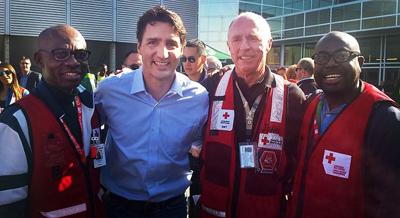
Manners and his fellow volunteers got an unexpected visit while serving in Edmonton, as Prime Minister Justin Trudeau stopped in to check on the operation.
Manners described Trudeau as “very personable and gracious.”
“He was concerned about the safety and well-being of the Canadian people … (and) wanted to make sure they were housed and fed adequately,” Manners said about Trudeau.
Hankes said the Red Cross in the United States will continue to help its neighbor to the north as long as necessary.
“We’re in it for the long haul,” Hankes said. “As long as the Canadian Red Cross needs the American Red Cross we’ll be there, and I know if we have a similar situation they’ll be there for us.”


