


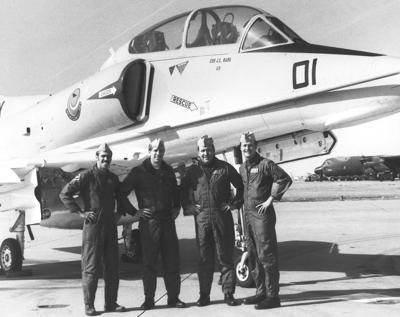
Retired Cmdr. James Karg, of Tellico Village, knew from a young age that he would serve in the military, going back to when he was a child during World War II.
“I was born in ‘37, so I was maybe 6 or 7 during the middle of the war, or 7 or 8,” he said. “My mother said, all you boys — there were four boys, and I had a sister — my mother said, ‘all you boys better serve in the armed forces or don’t come back here.’ I don’t know if she meant it or not, but all four of us served in the armed forces.”
So at the age of 22, after graduating college, Karg joined the U.S. Navy to be a pilot.
“I had just graduated college, and my dad thought I was stupid for going into the service because I had a college degree or whatever,” Karg said. “I don’t know. He just thought that was strange. He thought better of it after several years in the Navy. I spent 20 years, nine active and 11 in reserves.”
Karg had learned to fly in college as part of a flying club and logged 185 flying light air crafts before entering the Navy, which he said helped him in his training, which took place during an 18-month period.
“You spend 18 months in Navy flight training at least before you get your wings,” he said. “Then after you get your wings you go to a RAG squadron, a replacement air group, and you learn how to fly the airplane you’re going to fly in the fleet.”
When Karg finished his training the United States found itself in the thick of the Cold War with the Soviet Union, and Karg’s assignment was to be a nuclear weapons delivery pilot.
“It was the Cold War, and that’s why we were — our first mission was nuclear weapons delivery in the Balkan states, in Bulgaria, Romania, because they were satellite nations of the Soviet Union,” he said. “That was the mindset of the time.”
When the United States’ involvement in the Vietnam War escalated in the early 1960s, Karg, after a little more than three years aboard aircraft carriers and most recently in the Mediterranean, was assigned to the shore as an instructor for the Navy.
“I was rotated to shore duty, and the (commanding officer) wouldn’t let me go back into sea duty, so I requested the Air Force exchange,” Karg said.
Karg was moved to Korat, Thailand, and joined the Flying Tigers, a unit of pilots that was formed before World War II.
“In that time they were flying the F-105,” Karg said. “So I went through Korat, Thailand, and we flew combat missions up in almost strictly up in North Vietnam. ... Our main job was to knock down bridges so it would slow the flow of supplies into South Vietnam. That was our job, mostly. We did hit some airfields, destroying runways and hangers, stuff like that. Bridges were the main targets.”
The missions Karg faced while in Vietnam were some of the most dangerous that Air Force pilots have ever come up against, according to retired Air Force Maj. Gen. Fred Womack said.
Womack said more than 330 F-105 fighters were lost from 1965-1968, which he said was the highest loss rate in Southeast Asia.
“The mission he had, especially early on in the war, they lost almost 50 percent of the airplanes that were built,” Womack said. “They faced missiles. They faced small arm fire, and they faced anti-aircraft fire. It was probably the heavies air defense up until that time that our airmen had ever faced.”
During Karg’s runs, the air was so cluttered at times that it became difficult to see the target, Karg said.
“Well, Hanoi (Vietnam) was surrounded by 2,000 big gun sites, 50 (surface to air missile) sites, and I can remember rolling in on a target right in the middle of Hanoi — a bridge, there was a bridge going right through the middle there in Hanoi — and losing sight of the target because the flak was so thick,” Karg said. “... It was hairy, and then we encountered MiGs (fighter planes) on half our missions and had to tango with those guys. I got a couple shots at them, but I don’t think I hit them. It was just trying to scare them off or whatever and let them know they’d been shot at.”
On one flight, Karg’s fighter took serious damage.
“I think an .85 millimeter hit the back end of my airplane,” Karg said. “... I noticed that the airplane was real sluggish in control, didn’t have the same response, but I flew it out of there. The engine kept on running, and I flew it back to Thailand, Korat, and when I got back there they gave me a choice because they didn’t know if I was going to lose control of the airplane up close. At that time the ejection seats didn’t work so well down at low altitudes. You had to be at a higher altitude and a higher speed. ... They gave me a choice when I got back to Korat of trying to land it or ejecting. But I had already ejected once out of an airplane, and I got banged up pretty badly, and I’m still paying for it today. So I landed it, and it was okay. All’s well that ends well. I saved the airplane and didn’t have to eject out of it.”
The time Karg did have to eject came during his time in a replacement air group when he was flying an older model A-4 and experienced engine damage.
“The airplane’s on fire. Smoke is coming through the cockpit,” he said. “I was trying to get back to the field, but I was getting this tunnel vision, and that’s a sign that you’re going to be dead in seconds. So I just ejected, and I ejected too fast. ... I came down real hard, blew away part of my parachute and came down like a rock (and) got hurt. I was blind in one eye for about two days. But the worst of it was I got banged up in the hip and the leg.”
That incident kept Karg out of the air for just a couple of days. Karg’s love for flying kept him in the air then, and even after he retired from the Navy at age 42, he flew for Northwest Airlines.
“I loved it,” Karg said. “I tell everybody I cried when I retired from the Navy, but when I retired from Northwest I didn’t cry.
“... Really, the best part, and I realized this later, is I just associate with military people much better,” he added. “We just have kind of a respect for each other. ... I just have a lot of respect for other people that have served in the armed forces. I didn’t have to go into the service. I wanted to. I wanted to serve my country. I loved it.”
The latter years of Karg’s naval career were spent as part of an adversary squadron training other pilots.
“If you’ve seen the movie ‘Top Gun,’ I spent my last two years in an adversary squadron dog fighting against F-4s and F-14s because the A-4s had the qualities of the MiG 17s, which we encountered in Vietnam,” he said. “That’s why they used the A-4 ... so that they could learn how to maneuver against us and out maneuver us if they could.”
Karg said being in combat is something no one forgets and that several good pilots were lost during his time in Vietnam. But it’s an experience he wouldn’t trade.
“To me, he’s a real hero,” Womack said.


