


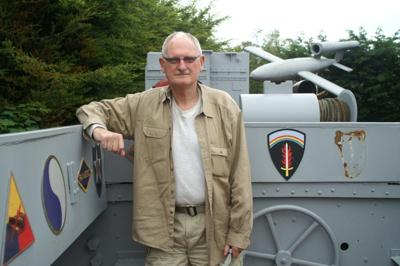
The U.S. Air Force was a part of Col. Donald Edmands’ life far before he ever enlisted in 1967 at the age of 22. Edmands’ father served in the Air Force, which led to a unique childhood.
“We lived on economies in France because we went over there in ‘53, which wasn’t long after World War II, so there was no facilities for Americans on base,” Edmands said. “So we lived in a French chateau, a couple of those, lived in a French hotel at one point. We lived on what you call lived on economy, and my playmates were French kids and things like that.”
At the time Edmands’ father was stationed in France, the country was still cleaning up from the damage of being the location for much of the fighting throughout World War II, and the signs of the war were everywhere, Edmands, who now lives in Tellico Village, said.
“When I lived there you could ride down the road and see a tank over in the field that had been blown up or shot or something,” Edmands said. “When I was young over there, that kind of stuff was everywhere. It isn’t now, which amazes me, absolutely amazes me. Now you go to Europe, and you see very little of the military stuff anymore. In fact, you have to look hard to find it. I can remember going down to Champs-Elysees in Paris. There’d be stalls just stacked with guns and swords and helmets and stuff like that. None now. You can’t find anything there anymore.
“I used to go out in the back yard — one chateau I lived in — we used to go out there and dig in the woods, and you’d dig out coins, explosives,” he added. “One guy found a bayonet digging out there one day. Out just right beside the house.”
After France, Edmands’ family lived in Japan, and he graduated high school in Okinawa. He returned to the United States to attend college at the University of Tennessee, and before finishing up a degree in logistics, he joined the Air Force.
“I had thought about making a career of the Air Force. My father was in the Air Force, so I spent my whole life near it,” Edmands’ said. “He was in the Air Force, and I was taking ROTC and thought when I graduate from college I’ll get a commission and probably make a career in the Air Force. They were about to draft me, and I called the draft board, and they said, ‘You’re on next month’s call.’ ... I ran downtown to the post office and joined the Air Force. I didn’t want to go in the Army, and they were going to draft me, so I ran down and joined the Air Force. The rest is history as they say.”
After his initial stint in the Air Force, Edmands finished out his degree and returned to the service with a rank of second lieutenant and began to work his way up the ranks.
“Most people stay in one place their whole career in the guard, but I went to Florida, then I went to Georgia, then I went to the District of Columbia, went on a bureau tour back to Florida,” he said. “I just moved around. That was the reason for my success I think. I didn’t homestead as they call it. I moved, and the thing with moving is there’s opportunity when you move. When you’re in the military, rank depends on the position you’re in. When you’re promoted — if I was to sit here and got promoted they’d move me to the place that equals the rank.”
Travelling from location to location is one of the things Edmands reflects on most fondly about his career in the Air Force and something he thinks many people today don’t understand about the service.
“I never did get to a conflict as much as I tried,” Edmands said. “You need to understand in the military there’s a ration of about one trigger puller to about seven people in support. An awful lot of people in the military never get to the conflict. Everybody thinks if I put a uniform on I’m going to end up in Iraq. Well that’s not the case. It depends on what you do, but that’s not the case.
“... I think the problem is all you see in the military is people fighting in Iraq and Afghanistan,” he added. “I think that’s the view of everybody of the military. There’s a whole big military that isn’t in Iraq and Afghanistan fighting, although if you’re in the military you’re liable to be there some day.”
By 1980, Edmands had been to every state, including Alaska and Hawaii, and he said he has knocked out what most people would consider “bucket list” locations.
“A lot of people have a lot of states, but do you have Hawaii and Alaska? But I hit 50 states by 1980 and a slew of countries,” he said. “I’ve been as far east as, I guess Turkey is the furthest east, and as far west as Korea. As far south as Brazil and, of course, Alaska to the north. ... You know you talk about bucket lists. I knocked everything off the bucket list, added some and knocked those off. I’m sitting here right now and really don’t have anything on the bucket list anymore.”
For Edmands’ wife, Mary, traveling from place to place has been a different experience from that of her husband, but a valuable one nonetheless.
Whereas Edmands spent his entire life moving around, Mary never left Georgia until her husband was moved to an assignment in Washington, D.C.
“He grew up as a military brat, and I grew up in the same place in south Georgia,” Mary said. “It’s really broadened my world, and I loved it very much.
“... Where we lived and worked was just at the very epicenter of the country’s history,” she added. “We took day trips all the time. Within a couple hours of our house were just so many things to see. Revolutionary and Civil War sites, history places. Thomas Jefferson’s home. ... It was just wonderful living up there.”
Military historian
A love for history has been a result of Edmands’ travels, specifically a love for the history of WWII that started during his days in France.
“I’ve always had a fascination — my wife teases me and says I was a Hitler nut — but I always had a fascination with the Nazis,” he said. “There was a lot of questions in my mind. How did they do that? How were they able — they literally took over a country and brought the whole world to war — and if they had done it right, if Hitler hadn’t been such a nincompoop, we could all be speaking German today. It was that close.
“Just being a little boy that whole thing intrigued me. I had a lot of questions over the year, and now I’ve answered a lot of them and researched and gone places and kicked the tires on stuff and answered a lot of questions I had. It just fascinates me, and it’s kind of like the more I do the more interested I am in it.”
Since retiring from the Air Force in 2007, Edmands has done a number of speaking engagements on the topic of WWII. He’s also traveled to numerous locations overseas where major events of the war took place.
“I admire him for that,” Mary said. “We had a wonderful time with his military career, and I really do miss the military career. I miss that a lot. We had a chance when we were stationed at Andrews up in D.C. to — he got me interested in some of the historic things. And then we love to travel overseas, and we go to a lot of military history sites overseas. I learned a lot of things from him. I’m more scientifically oriented because I’m a nurse, but I have seen a whole new perspective.”
But Edmands doesn’t just research and speak on World War II. He conducted a recent talk on the American Revolution, and later in the year he often gets asked to speak on an event in American history in which he was more directly involved — the events of Sept. 11, 2001. At that time, Edmands was stationed at Tyndall Air Force Base in Florida.
“The air defense of the United States was controlled out of Tyndall, First Air Force, and that’s where I was. I was in the First Air Force,” Edmands said. “My job was to ... maintain the software for the air defense systems, so I was all involved in air defense. When that started that morning I went down to the air operations center. ... I went down there and went in there and went up where (Maj. Gen. Larry Arnold) was and stood back behind him because he could reach out and (say) I need this right now, and I could go do it.
“We had no radar coverage in the United States,” he added. “I’m not saying there was not radar coverage, but it was not hooked into our system. So we’re trying to scramble a fighter to go look for an air liner, but we couldn’t see anything inside the United States. That’s what doomed us. That morning everybody was doing everything in the world to try to figure out where these airplanes were, and what we could do to respond to it, and we launched fighters up in Virginia and D.C. and everything, and we just couldn’t find them.
“... Everybody was doing everything they could, and we just didn’t have the tools. It’s changed now. We can see everything that moves in this country now. We couldn’t then. Things just changed then. I mean everything. Security level on the base and everything went up, and we went on 12-hour shifts, seven days a week around the clock. We didn’t know what would happen next. We had rumors they were going to start flying into buildings out in California, hijacking planes out there.”
From the perspective of military history, Edmands said Sept. 11, 2001, brought a lot of changes to the nature of war.
While Edmands’ military career ended in 2003, the retired colonel still makes it a part of his life and remembers the time fondly.
“I wouldn’t trade anything for it,” he said. “Your whole outlook on life is different. My wife will tell you that about me. You approach everything different. You look at people different. It’s just a whole outlook on life because you’re exposed to all the different cultures, all the parts of the world. I have traveled extensively since I retired. It’s kind of in my blood.”


